
Covington County Arrest Records and Court Charges
A Covington County arrest record is the account of an arrest itself. It names the person taken into custody, the agency that made the arrest, and the booking that followed. The Covington County Sheriff runs the county jail and keeps the jail docket. Sheriff Darrell M. Perkins serves as the county jailer. An arrest record can show the date of arrest, the arresting agency, and the booking detail held at the jail in Collins. An arrest does not decide guilt. It only records that a person was detained on suspicion of an offense. The charge record is a step beyond that point.
The court charge record is different. Once someone is arrested, a prosecutor reviews the case and decides the formal charges. Those charges are filed with the court clerk, where they become part of the public case file. The arrest and booking side stays with the jail, so the roster and booking detail belong with the county inmate records. The court charges after arrest are tracked through the case as it moves between courts. The full case file and final outcome sit with the criminal court records. Covington County does not publish an online jail roster, so current custody status is confirmed by calling the Sheriff at 601-765-8281.
How to Find Covington County Arrest Records and Charges
Covington County does not run one public arrest database. Access works through several channels. The statewide tool is Mississippi Electronic Courts, known as MEC. Electronic filing is now complete in all circuit, chancery, and county courts. The public can view eligible case documents through Public Access Mississippi Electronic Courts, or PAMEC. Registration costs $10 per year, and viewing documents runs 20 cents per page. Charges and charge status appear in the case file once a prosecutor files them. Booking and arrest detail are not in PAMEC, because that information stays with the sheriff and jail.
- Register for a PAMEC account and sign in to the statewide case viewer.
- Search by the defendant's name or by a known case number.
- Open the matching case and read the list of charges filed.
- Check each charge's statute code, level, and current status.
For records that are not online, contact the clerk who holds them. The Circuit Clerk keeps felony case files. The Justice Court Clerk handles first appearances, affidavits, and county misdemeanor charges at 601-765-6581. Statewide rollups are limited. The Mississippi Department of Corrections inmate search covers state prisoners, not county jail bookings. Mississippi has no free public website that returns a full personal criminal history. A complete background check runs through fingerprint-based channels instead.
From Arrest to Court Charges in Covington County
Most charges in Covington County follow a clear path. An arrest comes first, and the sheriff books the person at the county jail in Collins. The case then moves fast to Justice Court. All felony cases are first heard there for an initial appearance and the filing of an affidavit. Justice Court judges hold jail sessions three times each week. That schedule protects each person's right to an initial appearance within three days of arrest. At this stage the judge reviews the charge and sets bond. The affidavit and the first-appearance entries form the earliest part of the charge record.
Mississippi State University Extension explains the role of the local judge in this first step in its Justice Court judge guide.
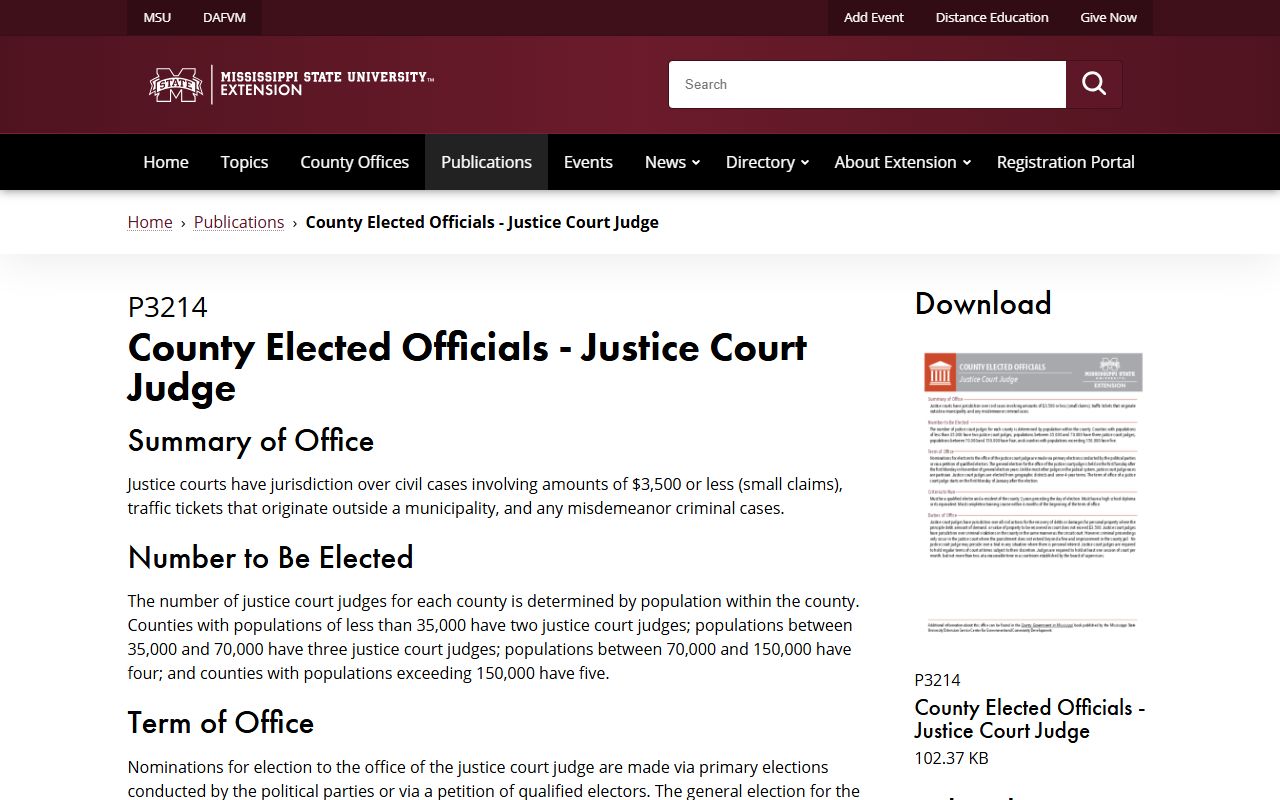
That guide shows why a Covington County arrest often reaches a Justice Court judge within days, well before any felony charge is formally filed. From there the case can move up. A misdemeanor may stay in Justice Court or a municipal court. A felony heads toward Circuit Court. District Attorney Chris D. Hennis prosecutes felonies for the Thirteenth Circuit District, which covers Covington, Jasper, Simpson, and Smith counties. His office decides what to charge. A grand jury may return an indictment, or the state may proceed by information. From that filing forward, the formal charges and the full case file live with the Circuit Clerk.
Note: A single Covington County arrest can produce a Justice Court affidavit, a sheriff booking entry, and a later Circuit Court indictment, all tied to one event.
How Charges Get Filed After an Arrest: Complaint, Information, and Indictment
The charge record begins when a prosecutor files a charging document. An arrest alone is not a charge. The document names the offense, cites the statute, and starts the case in court. Mississippi uses three main charging documents. The type depends on how serious the offense is and which court hears it. The Mississippi Bar lays out how those court levels fit together for the public.
The Mississippi Bar describes each court level and what it handles in its guide to the court system.
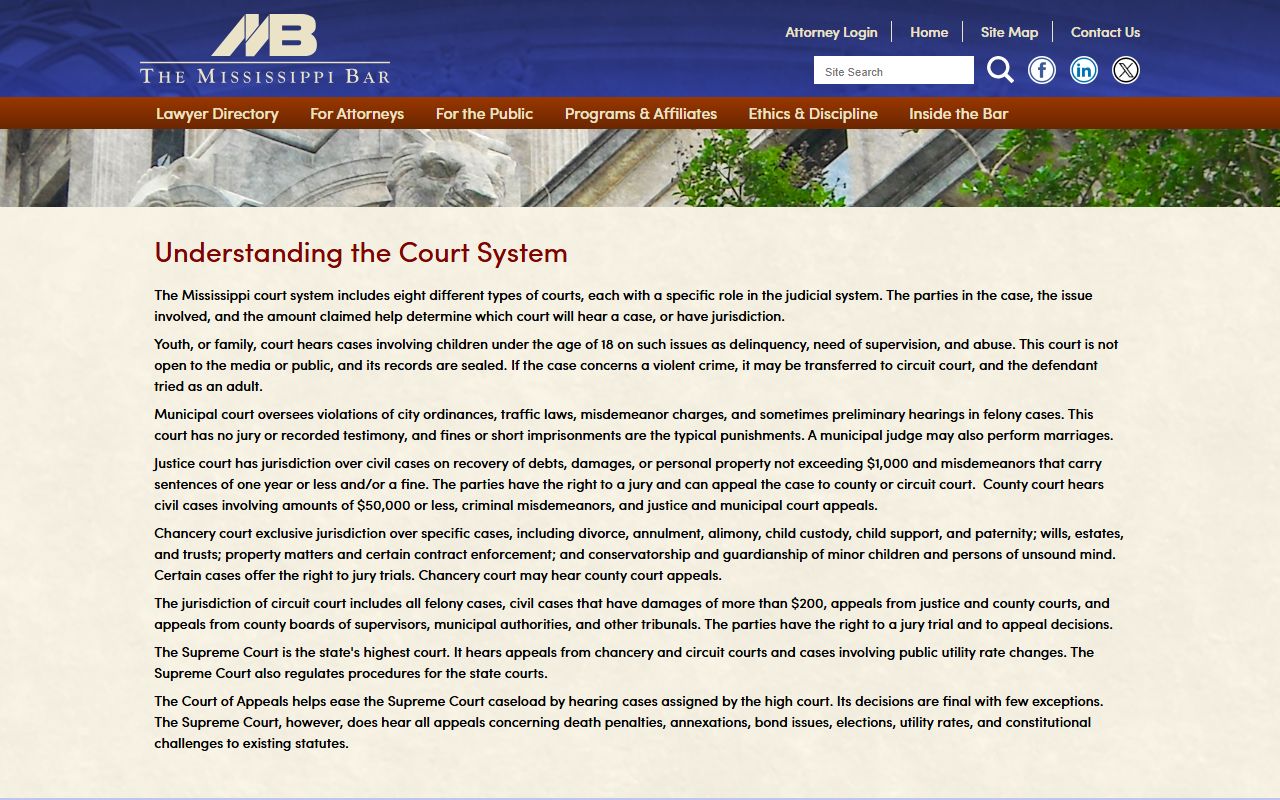
That overview helps readers see which Covington County court will hold a charge record, from Justice Court misdemeanors to Circuit Court felonies. The table below sorts the three documents by who files them and the offenses they usually cover.
| Complaint | Information | Indictment | |
|---|---|---|---|
| Filed By | Officer / Prosecutor | Prosecutor | Grand Jury |
| Common For | Misdemeanors | Many felonies | Serious felonies |
| Starts | The case | The case | The case |
Charge Status in Covington County Court Records
Charges do not stay frozen. As a case moves, charges can be amended, reduced, added, dropped, or dismissed. The status shown in the case file tells you where each charge stands. Reading the status matters as much as reading the charge. A charge listed at arrest may look very different by the time the case closes. The terms below appear often in Mississippi court files.
| Status | What It Means |
|---|---|
| Pending | The charge is filed and active; the case has not reached a final outcome. |
| Amended / Reduced | The prosecutor changed the charge, often to a lesser offense. |
| Dismissed | The court dropped the charge, and it will not move forward. |
| Nolle Prosequi | The prosecutor chose not to pursue the charge, ending it for now. |
Charges vs. Convictions
Being charged is not the same as being convicted. A charge is an accusation. A conviction is a finding of guilt by plea or by verdict. Many charges never become convictions. Some are dismissed, some are reduced, and some end in an acquittal. Both the charge and the conviction can appear in the public record, so the disposition is the field that matters most. The comparison below sets the two stages side by side.
| Charge | Conviction | |
|---|---|---|
| Stage | Accusation | Verdict or plea |
| Burden of Proof | Probable cause | Beyond reasonable doubt |
| Public Record | Yes | Yes |
Covington County Charge Codes and Severity Levels
Each charge ties to a section of the Mississippi Code. The case file lists the statute number next to the offense. The code points to the exact crime and its level. Mississippi sorts crimes into felonies and misdemeanors. A felony is the more serious class and can carry a year or more in state custody. A misdemeanor carries lighter penalties and is usually handled in Justice Court or a municipal court.
One arrest can produce several separate charges, each with its own code and level. The level also decides which court hears the case and where the record is kept. A felony charge moves to Circuit Court, while a misdemeanor stays at the lower level. When you read a charge, check the statute cite first, then the level, then the status. Those three fields together tell you what the charge really means and how far the case has gone.
Statewide Charge Lookups for Covington County
Charges filed in Covington County can roll up into statewide systems. None of these is a single free criminal-history search. The Mississippi Department of Corrections runs an inmate and parolee search for people in state custody. That tool covers state prisoners, not county jail bookings. The Mississippi Department of Public Safety hosts the statewide sex offender registry. A full personal criminal history in Mississippi comes from a fingerprint-based check, not a public web search.
Public access to these records rests on state law, set out in the Mississippi Public Records Act.
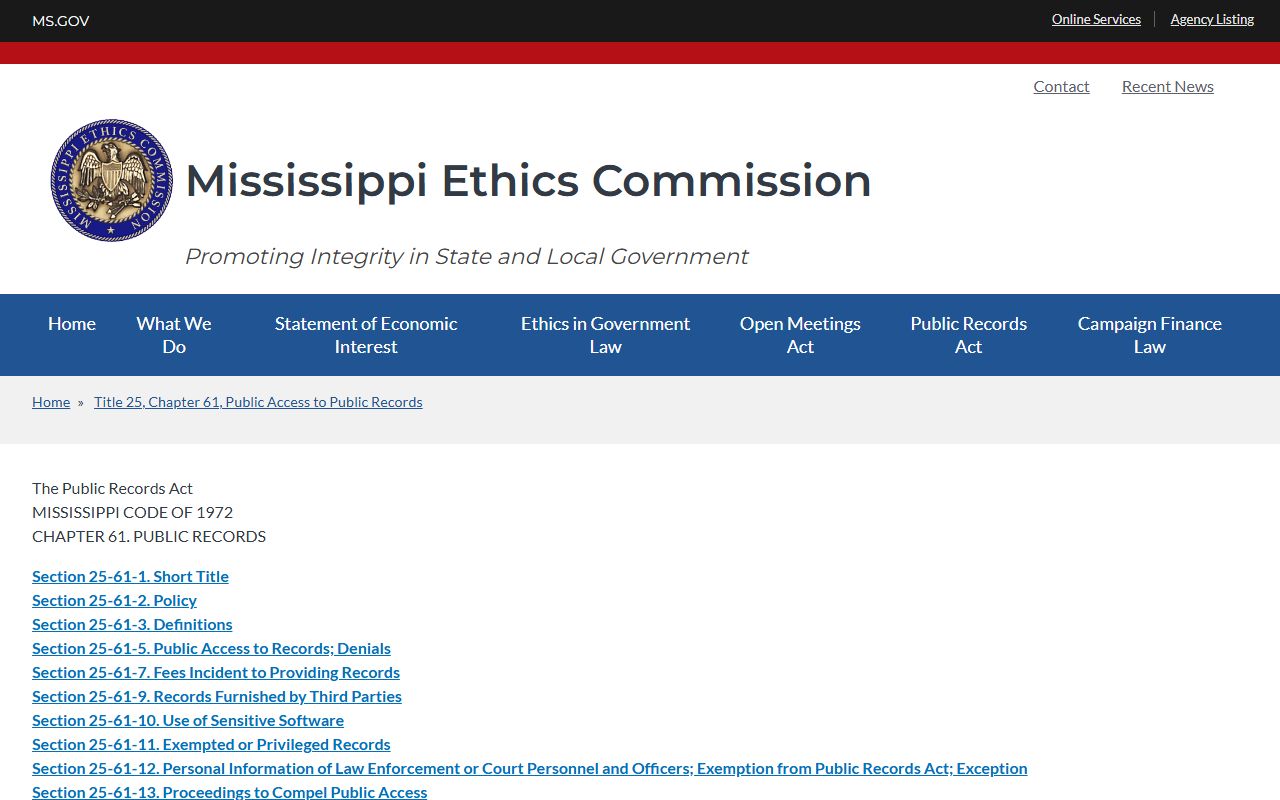
Under that Act, Covington County offices must answer a records request within one working day and generally produce nonexempt records within seven working days. When charge records are not online, this law is the backstop. Any person may inspect or copy nonexempt public records. Offices may charge actual costs for search, copying, and mailing. Incident reports are public, while active investigative files may be withheld. For a Covington County charge that predates electronic filing, a written request to the clerk or sheriff is often the fastest route.
Background Check Considerations
A casual name search is not a background check. Employers, landlords, and licensing boards must follow the federal Fair Credit Reporting Act, or FCRA, when they screen people. An FCRA-compliant report comes from a regulated agency and follows strict rules on accuracy, notice, and consent. A quick lookup of charges does not meet that standard. Charges shown online may be incomplete, sealed, reduced, or out of date.
Important: This site is not a consumer reporting agency under the FCRA, and its information cannot be used for employment, housing, credit, or other regulated screening decisions.
Sealed vs. Expunged Records
Some charge records are removed from public view. Mississippi uses both sealing and expunction. Sealing hides a record from ordinary public access. Expunction removes an eligible arrest or conviction record so it is treated as if it never happened. Eligibility is narrow and depends on the offense, the disposition, and the time that has passed. A petition is filed in the court with authority over the record, such as the Circuit Clerk for a felony or Justice Court for a lower-court charge.
| Sealed | Expunged | |
|---|---|---|
| Visibility | Hidden from public | Removed; treated as never existed |
| Law Enforcement | Limited access | Very limited |
| Eligibility | Set by court order or statute for limited categories | Offense-, disposition-, and timing-specific under Mississippi law |
Note: An expunged Covington County charge may vanish from public search yet still be visible to courts and law enforcement allowed access by law.
Restricted Charge Records in Covington County
Not every charge is open to the public. Covington County Youth Court records are confidential by law. They cover delinquency and child-welfare matters and are not ordinary public records. Sealed and expunged charges are blocked or removed from public access. Active investigative files may be withheld until a case is resolved, though incident reports stay public.
Personal identifiers are redacted under state privacy rules. That includes Social Security numbers, financial account numbers, victim details, and the names of minors. The Public Records Act lets an office redact exempt material and release the rest. To learn whether a specific charge can be released, ask the clerk for the court that holds it. For a felony, that is the Circuit Clerk. For a county misdemeanor or first appearance, that is Justice Court. The warrant and bond entries tied to a charge may also appear in those same files.