
How to Search Covington County Court Records
There is no one website that holds every Covington County court record. The search reality is multi-channel. Statewide cases live in Mississippi Electronic Courts, known as MEC, with public viewing through Public Access Mississippi Electronic Courts, or PAMEC. Land records and Board of Supervisors minutes sit in a separate county portal called Chancery Records Online. Everything else runs through the clerk who keeps the file. That means the Circuit Clerk, the Chancery Clerk, the Justice Court clerk, or a municipal court clerk, depending on the case.
The county courts are clustered in Collins, the county seat, at the historic Covington County Courthouse. The Mississippi Judiciary publishes the statewide framework that explains how these courts fit together. A quick look at its homepage shows the entry points for electronic access and the court directory.
Lead with the source you are searching from. The Mississippi Judiciary site links MEC, the appellate courts, and the trial court structure for every county.
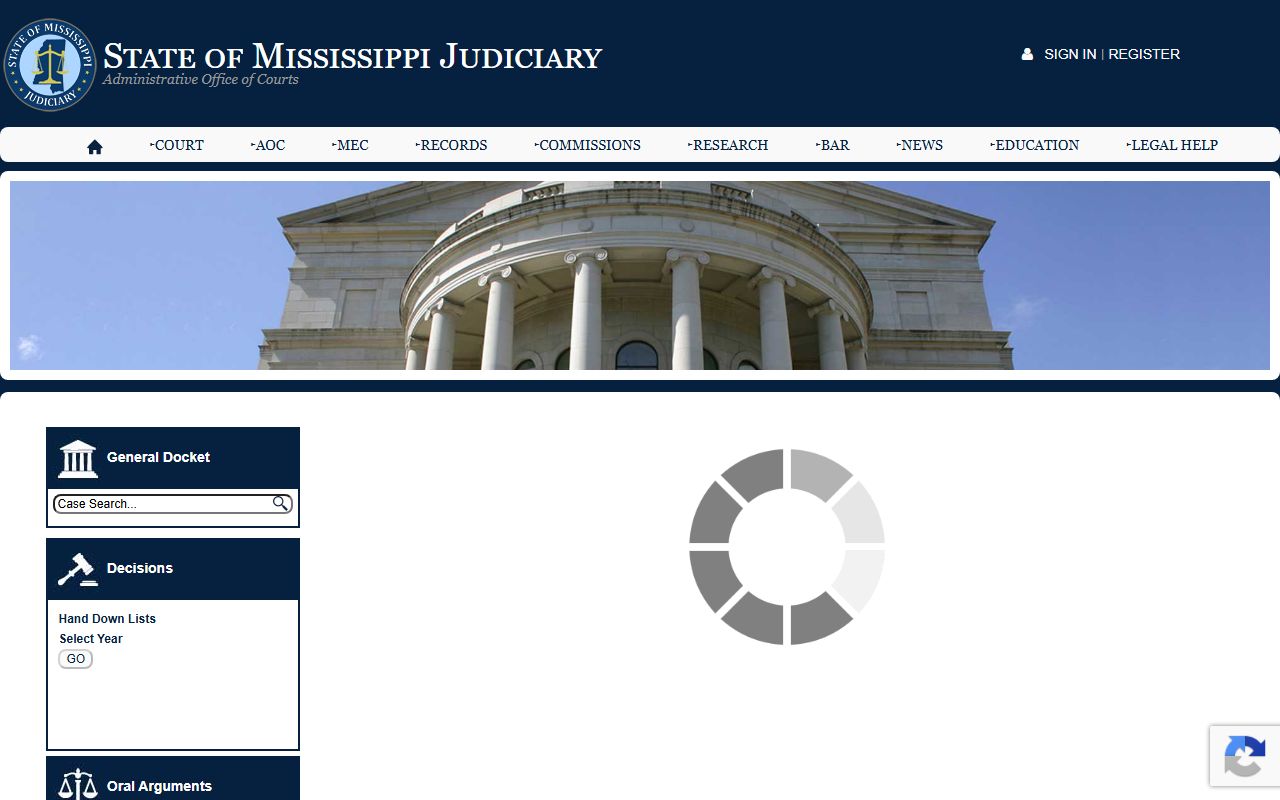
From that homepage, a searcher can reach the electronic case system and confirm which trial court handles a matter. Before starting, gather the names of the parties, an approximate filing date, the case type, and a case number if one is known. Then follow these steps in order to route the search correctly.
- Identify the court level and the clerk who holds the record. Felony and major civil files are Circuit Court. Divorce, estates, and land disputes are Chancery Court. Small cases and county tickets are Justice Court.
- Use MEC and PAMEC for eligible Circuit, Chancery, and County Court electronic case information when it is available online.
- Use the Chancery Records Online portal for land records and Board of Supervisors minutes only, not for general criminal or civil case dockets.
- Contact the Circuit Clerk, Chancery Clerk, Justice Court, or the right municipal court directly when the record type is not online.
- Use state agency systems for state custody, driving records, vital records, and the sex offender registry.
Searching Court Records Through MEC and PAMEC
Mississippi has finished rolling out electronic filing statewide. The Judiciary reports that MEC is now live in all circuit, chancery, and county courts, which includes Covington County. The public can view case documents through PAMEC after creating an account and paying an annual registration fee of ten dollars. Document viewing then costs twenty cents per page. The Mississippi Electronic Courts page is the official entry point for system information and the helpdesk.
That state page describes how the electronic system works and which courts take part. It is the place to confirm that a court is on MEC before trying to view a file.
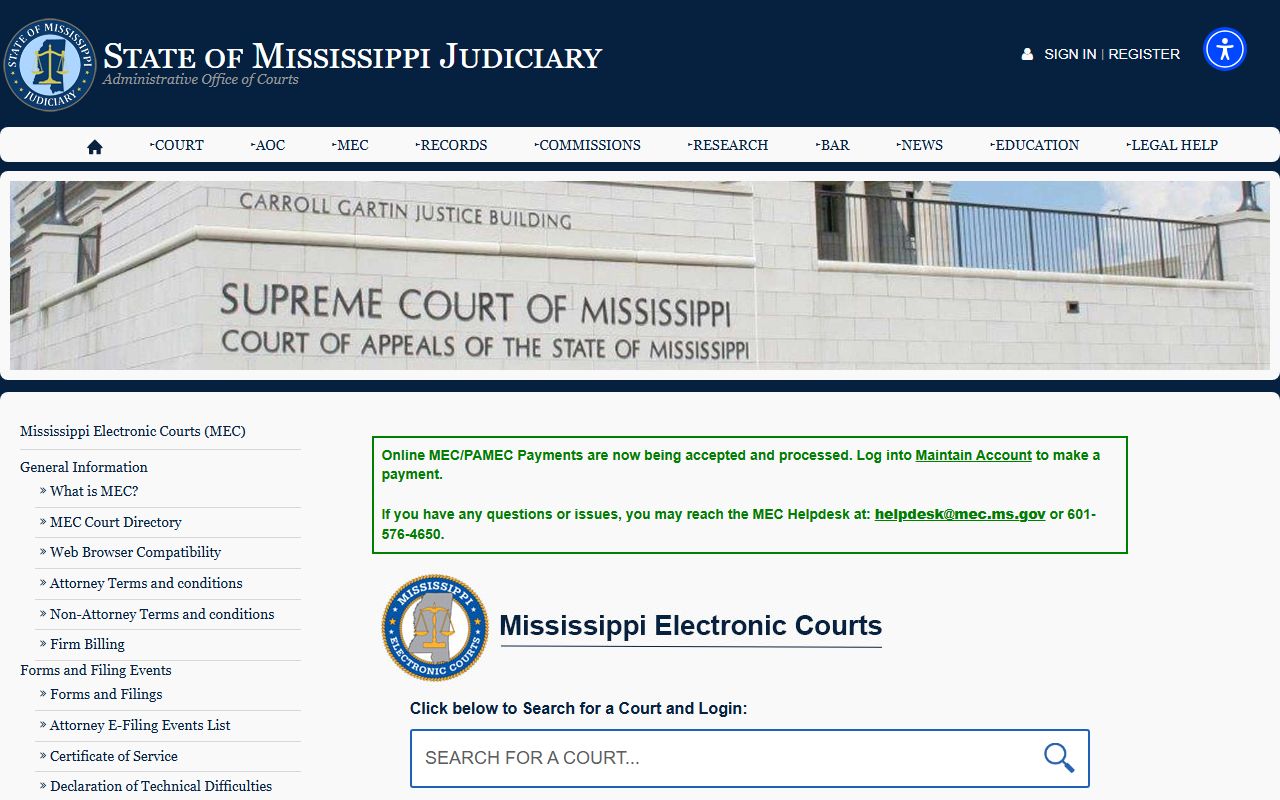
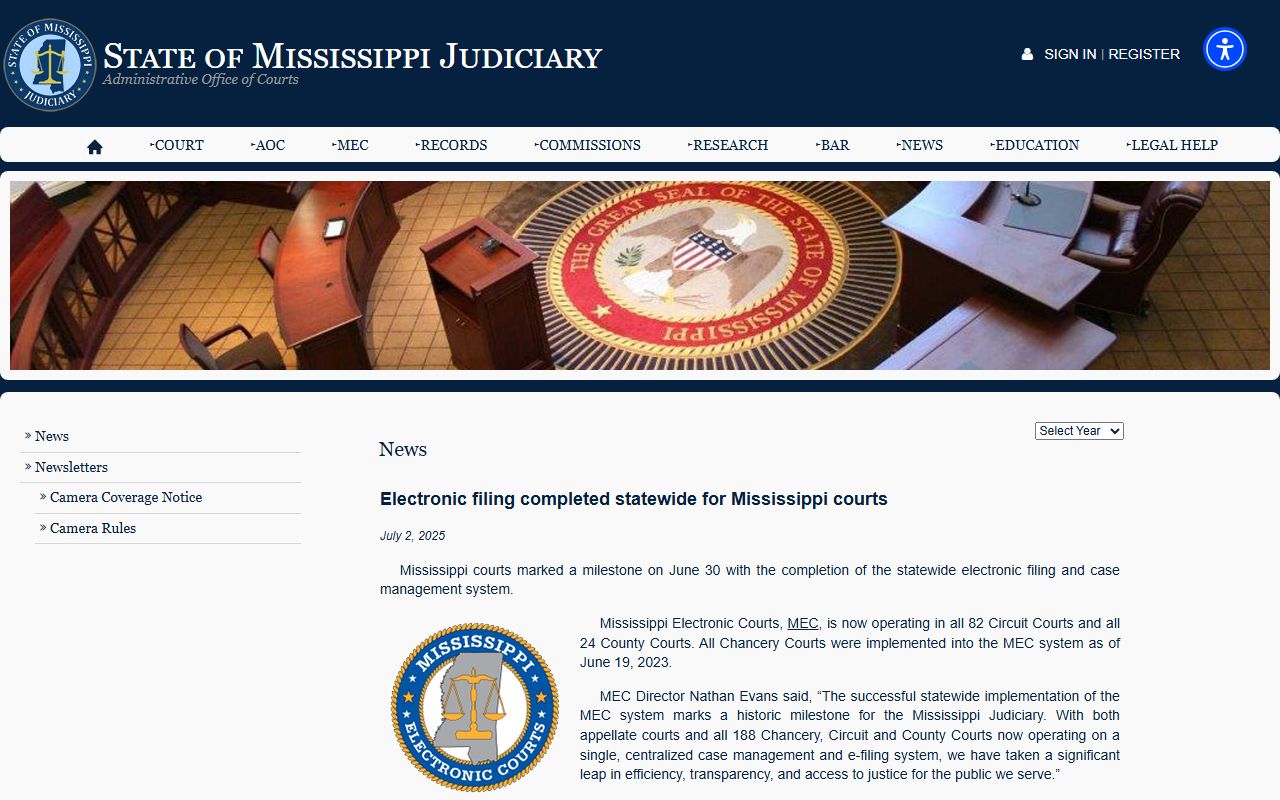
One limit matters a great deal. Remote access is blocked for some restricted case categories, including sensitive family matters and protective-order files. Those records are not viewable from home even when the case exists. The statewide e-filing news release spells out the fee structure and the access rules.
The release confirms the ten-dollar registration and the per-page charge, and it is a useful reference when planning a paid search.
Public users register and then sign in to reach the case interface. The login screen itself is short. It asks only for the credentials tied to your paid account, not for case details. The fields below show what the PAMEC sign-in page requires.
| Field Label | Type | Required | Notes / Format |
|---|---|---|---|
| Username | Text | Yes | Placeholder reads "Enter Username"; up to 12 characters. |
| Password | Password | Yes | Placeholder reads "Enter Password"; up to 32 characters. |
| Enter | Submit button | Yes to submit | Button labeled "Enter" runs the sign-in. |
Sidebar links on that page handle New Registration, Maintain Account, Forgot Password, and Forgot Username. New users register at the public MEC registration site, then return to log in. Case searching only begins after an account is active and you reach the authenticated interface.
Note: The PAMEC login page is for account maintenance only, so actual case searching opens only after you sign in with an active paid account.
The Covington County Chancery Records Online Portal
The Chancery Clerk runs a separate web portal at Chancery Records Online. This is a common point of confusion. The portal holds land records and Board of Supervisors minutes only. It is not a case docket system for criminal, civil, divorce, or probate files. Those belong to MEC or the clerk counter, not to that land-record portal.
The portal offers two applications: Official Land Records and Board Minutes. The clerk warns that the online land index is not the official index, and that only the Land Records Index kept inside the courthouse should be treated as official. Users also agree to a liability and indemnity disclaimer before searching. The land-record application loads as a single-page app and does not expose a stable list of search fields without an interactive session.
The Board Minutes search is more open. It lets the public look up county meeting minutes by date range, official book and page, keyword, or minute-line description. The fields below show what that search form offers.
| Field Label | Type | Required | Notes / Format |
|---|---|---|---|
| 12 months | Radio | Optional | Date range; checked by default. |
| 2 years | Radio | Optional | Date range covering two years. |
| All Meetings | Radio | Optional | Searches the full record set. |
| Begin Date / End Date | Text or date | Optional | Free-text date boundaries for a custom range. |
| Official Book | Text | Optional | Placeholder "Official Records Book." |
| Official Page | Text | Optional | Placeholder "Official Records Page." |
| Keyword Search | Text | Optional | Searches item description or document text; disabled when minute-line search is active. |
| Minute Line | Text | Optional | Searches a minute-line description; disabled when keyword search is active. |
After a search runs, results appear in a selectable list. Clicking a row opens the meeting detail, with the meeting date, title, notes, status, line items, a book and page marker, and a PDF viewer that supports zoom and full-screen viewing. A button can email the page link to a recipient. The Board Minutes search is free to use and does not require an account.
Types of Covington County Court Records
The record you need is shaped by the court that made it. Mississippi splits trial work between Circuit Court and Chancery Court, with Justice Court and the municipal courts handling smaller matters. Each court generates its own kinds of files. The Mississippi Judiciary court-structure page describes how each level works.
That overview lays out the role of every court from the Supreme Court down to Youth Court, which helps a searcher pick the right office.
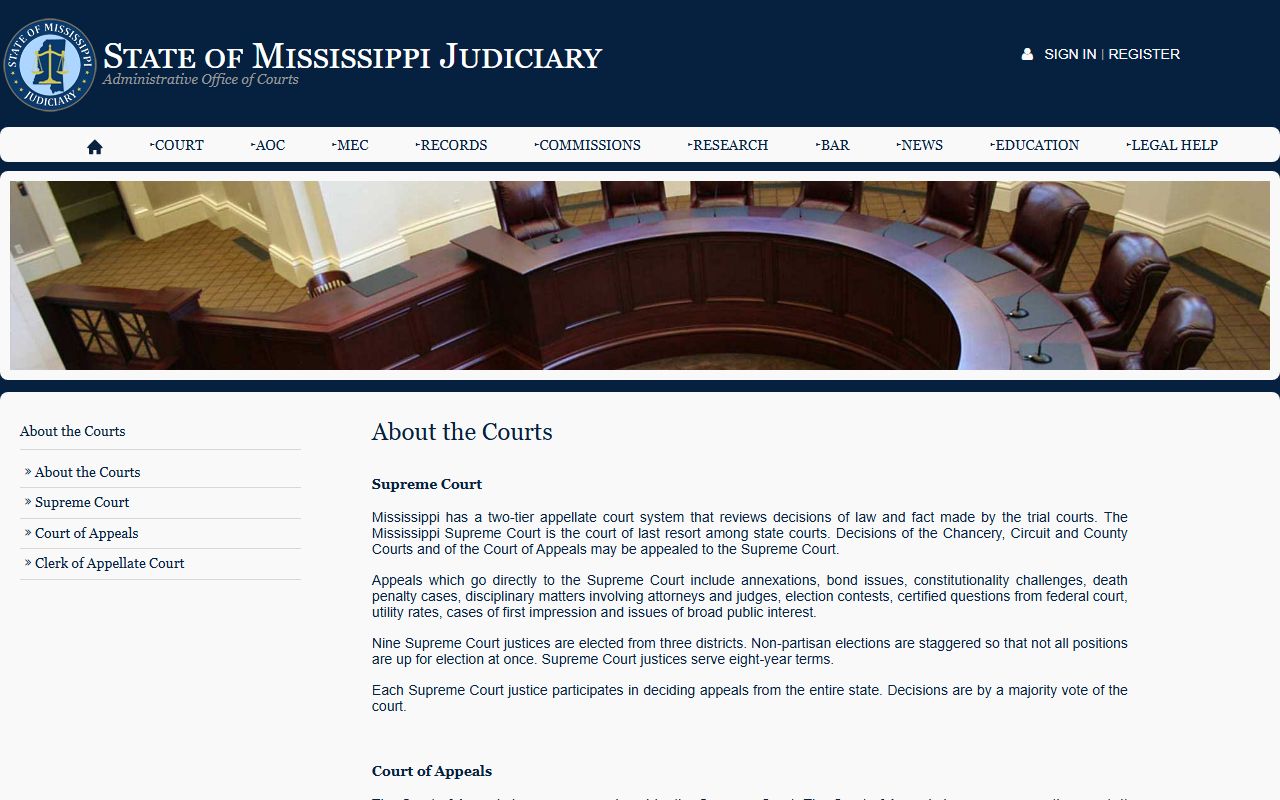
Circuit Court holds civil cases and felony criminal files, with complaints, indictments, motions, verdicts, judgments, and sentencing orders. Chancery Court keeps divorce, custody, estate, guardianship, conservatorship, and land-title files. Justice Court holds small civil suits, county and highway-patrol traffic tickets, DUIs, and felony first appearances. The main record groups in the county break down like this.
- Circuit Court civil and criminal case files, including jury matters and appeals from lower courts.
- Chancery Court family and equity files, such as divorce, adoption, estates, and property disputes.
- Justice Court records for small claims, county tickets, misdemeanors, and bonds.
- Municipal Court records for city ordinance and city traffic cases in Collins and Mount Olive.
- Land and property records and Board of Supervisors minutes kept by the Chancery Clerk.
Marriage records sit with the Circuit Clerk, who issues licenses and keeps the marriage record. Youth Court files for delinquency and neglect are confidential and are never treated as ordinary public records. For a closer look at how active and upcoming cases are listed, the Covington County court dockets page covers calendar and docket access.
What Covington County Court Records Show
The exact fields vary by court and by access channel, but most case records carry the same core data. A file identifies the parties, the court, the judge, and the path of the case from filing to disposition. Financial entries track fees, fines, bonds, and costs. Document images may appear in MEC for twenty cents per page. The table below outlines what each common field shows.
| Field | What It Shows |
|---|---|
| Case Number | The court's unique file identifier used to pull the record. |
| Court | Which court holds the case: Circuit, Chancery, Justice, Youth, or municipal. |
| Filing Date | The date the complaint, indictment, petition, or charge was filed. |
| Party Names | Plaintiff and defendant, state and defendant, petitioner and respondent, or estate parties. |
| Attorneys | Counsel of record, the prosecutor, and any appointed or public defender shown. |
| Judge | The assigned circuit, chancery, justice, or youth court judge. |
| Status | Pending, open, closed, disposed, dismissed, transferred, appealed, sealed, or restricted. |
| Docket Entries | Each filing and event, from summons and motions to orders, judgment, and appeal notice. |
| Disposition | The final outcome, such as dismissed, guilty, judgment entered, or decree granted. |
| Financial Fields | Filing fees, fines, court costs, bonds, restitution, and document-viewing charges. |
Sensitive data is redacted before release. Social Security numbers, financial account numbers, victim identifiers, minor names, and medical details may be withheld. A felony file moving through Covington County criminal court records will show charges, pleas, the verdict, and the sentence in these same fields.
Public Access Laws for Covington County Court Records
Public access starts with one question: which public body holds the record. The Mississippi Public Records Act, found at Miss. Code Ann. Section 25-61-1 and following, makes public records open for inspection unless a statute makes them exempt or confidential. The Mississippi Ethics Commission publishes the full text of the Act and explains how requests work.
Any person may inspect or copy public records under reasonable written procedures. Under Section 25-61-5, when an office has no written procedures, access should be given within one working day, and a record or a denial generally must come no later than seven working days. Section 25-61-7 lets a public body charge fees set to recover the actual cost of searching, reviewing, copying, redacting, and mailing, and it may require payment in advance. Section 25-61-12 keeps incident reports public while exempting certain personal information of law enforcement officers, judges, and prosecutors.
No Covington County clerk fee schedule for court copies, certified copies, or public-records requests was found in official online sources. Fee not located in official online Covington County sources; call the Circuit Clerk at 601-765-6506 or the Chancery Clerk at 601-765-4242 before mailing a request or arriving for certified copies.
Note: Even when a record is public, an office may redact exempt material and release only the parts of the file that the law allows the public to see.
Records That Are Sealed or Confidential in Covington County
Some Covington County court records are closed to the public by law or by court order. Youth Court files for delinquent children, children in need of supervision, and abused or neglected children are confidential. Access is limited to court staff, parties, attorneys, authorized agencies, and people named in a Youth Court order. Adoption files are also generally confidential, and even the existence of an adoption case is not an ordinary public record. Mental commitment files handled in Chancery Court often hold medical and personal details and are treated as restricted.
Sealed records are blocked from normal public access by a court order. Expunged records are removed from public criminal-history and court channels to the extent the order requires. An expunged case may vanish from public search yet still be visible to agencies the law allows. To view a sealed file, a person usually must ask the court that holds it and show legal authority or a qualifying interest.
Someone seeking expunction should start with the exact arrest, charge, court, and disposition. For a felony or a Circuit Court misdemeanor, call the Circuit Clerk. For a Justice Court charge, call Justice Court first, and also check Circuit Court if the case was bound over or indicted. A petition is normally filed in the court with authority over the record, and the judge decides whether the law allows the record to be sealed or expunged.
In-Person and Clerk Court Record Requests
When a record is not online, the fastest path is the clerk who keeps it. The county courts share the Covington County Courthouse in Collins, but the offices have separate counters and duties. The Circuit Clerk handles Circuit and County Court files, marriage licenses, and judgments. The Chancery Clerk handles Chancery Court, probate, divorce, land records, and board minutes. Bring a case number or full party names, and confirm hours and copy fees before traveling. Justice Court records run through clerk Cassity Booker at 601-765-6581, and city tickets go to the Collins or Mount Olive court that issued them.
Covington County Circuit Clerk
Melissa Duckworth, Circuit Clerk
PO Box 667
Collins, MS 39428
601-765-6506
Monday to Friday, 8 a.m. to 5 p.m.
Covington County Chancery Clerk
Guy Easterling, Chancery Clerk
PO Box 1679
Collins, MS 39428
601-765-4242
Monday to Friday, 8 a.m. to 5 p.m.
You can also reach each office by phone, email, fax, or mail. The Circuit Clerk can be emailed at mduckworth@covingtoncountyms.gov and the Chancery Clerk at geasterling@covingtoncountyms.gov. A written request under the Public Records Act can be sent to the office that holds the file, since no county-specific request form was located online. For driving and citation files, the state driver record system is a separate channel from the county courts, and traffic cases are detailed on the Covington County traffic court records page.