
What Probate Covers in Covington County
In Mississippi, probate is Chancery Court work. There is no separate probate court. The Chancery Court handles estates of people who have died, along with wills, guardianships, conservatorships, and related family and property matters. The county courts listing for Covington County states that Chancery Court hears estates of decedents, insurance settlements paid to minors, commitments of mentally disabled persons, title confirmation, land issues, and property disputes. So a single court manages both the death side and the protective side of probate work.
The same court also handles divorce, child custody, adoption, and disputes in equity. That mix matters for record seekers. A family estate file, a minor's settlement, and a guardianship can all live in the Chancery system under the same clerk. Mississippi probate history is tied to Chancery Court rather than a stand-alone probate bench, which is why estate questions route there.
The Mississippi Judiciary explains the role of these courts statewide. You can read the official overview on the Mississippi Chancery Courts page, which describes equity, domestic, guardianship, conservatorship, estate, and land jurisdiction.
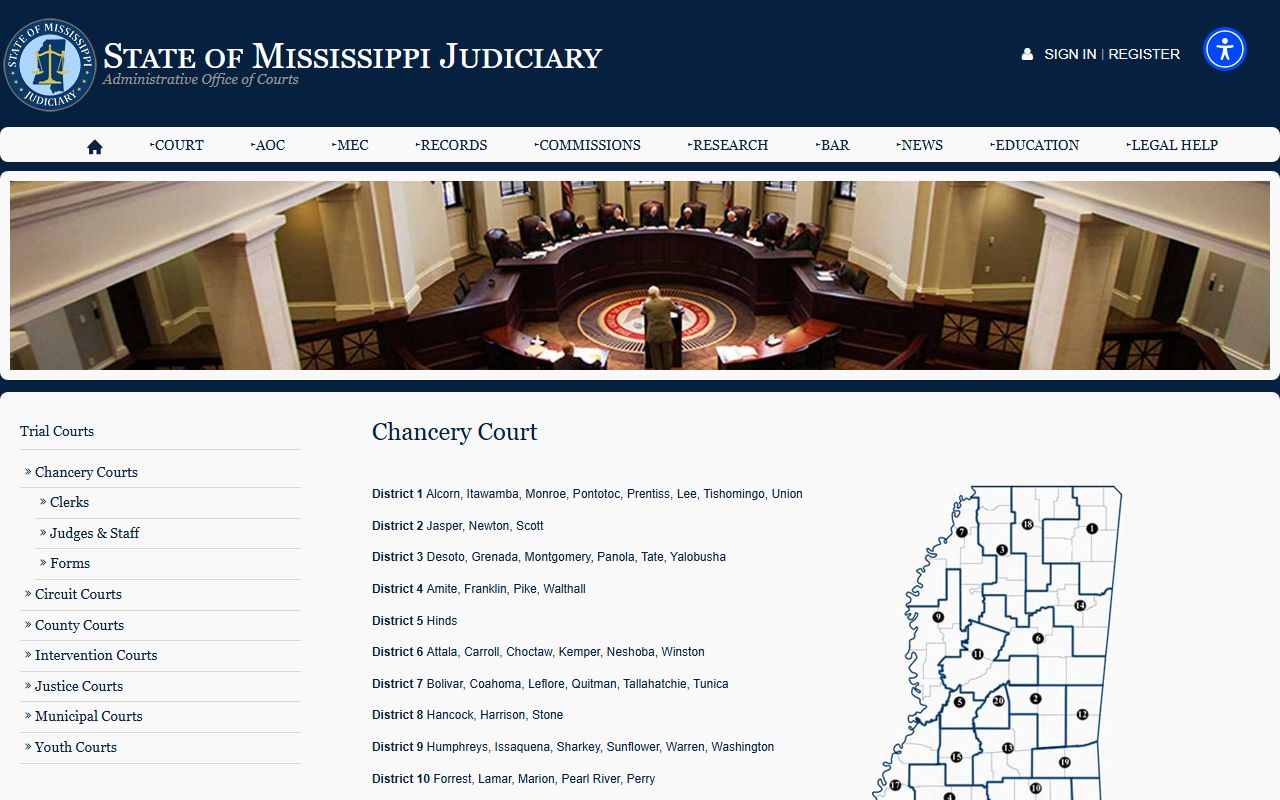
The statewide page confirms that estate and guardianship cases belong to Chancery Court, the same court that holds Covington County probate records. It is a useful starting point before you contact the local clerk.
Probate Terms Defined
Probate paperwork carries words that do not come up in daily life. A few short definitions make an estate file easier to read. These terms appear across Covington County probate filings, from the first petition to the final decree.
- Testator
- The person who made the will. After death, the will is offered for probate in Chancery Court.
- Executor / Administrator
- The person who settles the estate. An executor is named in a will. An administrator is appointed by the court when there is no will or no named executor.
- Intestate
- Dying without a valid will. State law then decides who inherits, and the court appoints an administrator.
- Letters testamentary
- The court order that proves an executor's authority to act for the estate. Letters of administration do the same job when there is no will.
- Guardianship
- A court arrangement giving an adult legal authority over a minor or that minor's property, such as an insurance settlement paid to a child.
- Conservatorship
- A court arrangement that places an adult who cannot manage personal or financial affairs under the care of an appointed conservator.
Covington County Chancery Court Contacts
Probate filings and estate records sit with the Chancery Clerk, who serves as Clerk of the Chancery Court. Guy Easterling holds that office for Covington County. The Chancery Court itself belongs to the Thirteenth Chancery District, which also covers Jefferson Davis, Lawrence, Simpson, and Smith counties. The district judges are the Hon. David Shoemake and the Hon. Gerald Martin.
The district maintains an official site for the Thirteenth Chancery District. You can view its jurisdiction details on the Thirteenth Chancery Court District website, using only the official court portions for court facts.
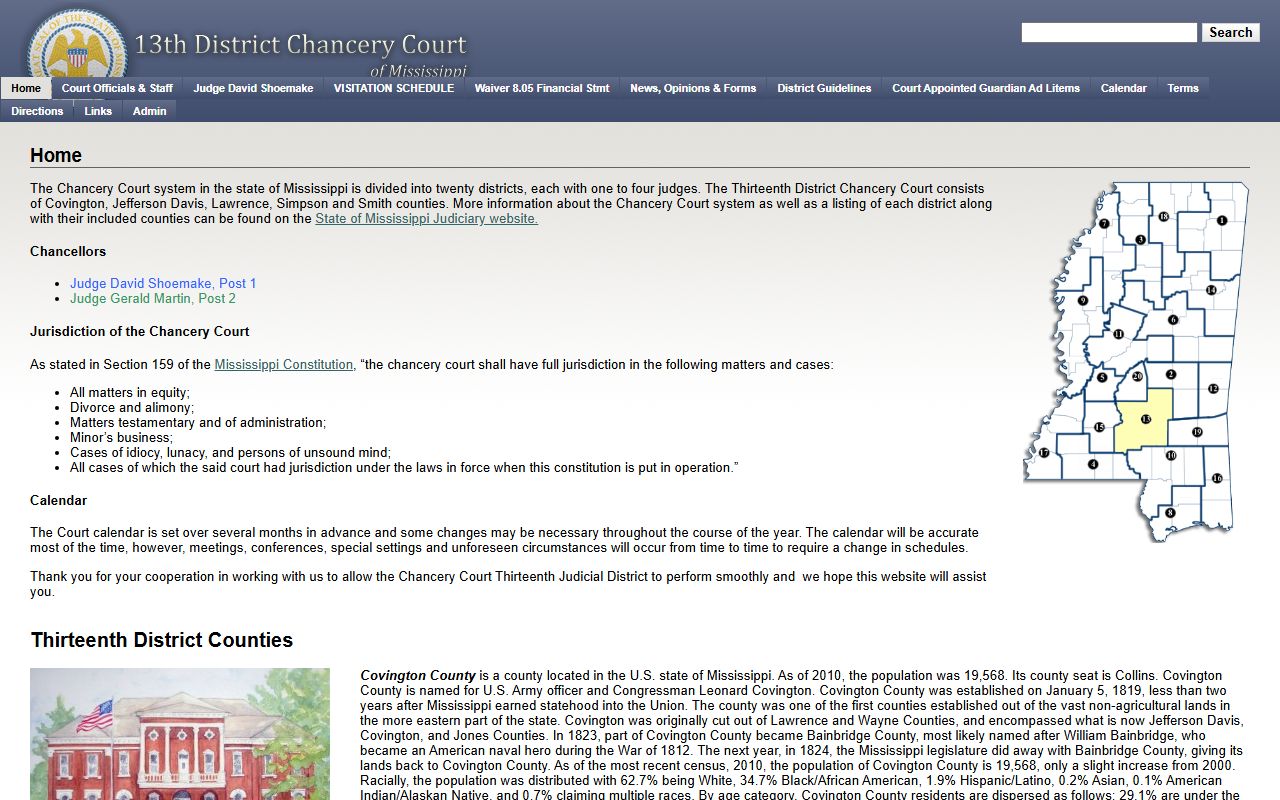
That district page confirms which court handles Covington County probate records and which counties share the same chancery bench. For the actual estate files, the local clerk is the office to call or visit.
Chancery Court, Thirteenth Chancery District
Covington County Courthouse
101 South Dogwood Avenue
PO Box 1679
Collins, MS 39428
601-765-4242
Covington County Chancery Clerk
Guy Easterling, Chancery Clerk
PO Box 1679
Collins, MS 39428
601-765-4242
Fax 601-765-5016
Monday to Friday, 8 a.m. to 5 p.m.
How to Search Covington County Probate Records
There is no single public website that returns every Covington County probate file. Access runs through more than one channel, and the right one depends on the age of the case and the type of record. Newer estate filings may appear in the statewide electronic system, while older estates and full files stay with the clerk.
Mississippi now runs court records through Mississippi Electronic Courts. The public version, PAMEC, lets registered users view eligible Chancery, Circuit, and County Court documents. Public users pay a small annual registration fee and a per-page charge to view documents. Sensitive categories are not available remotely, so many guardianship and conservatorship items will not show online. You can register at the public MEC registration site and learn more on the Mississippi Electronic Courts page.
Note that the county's Chancery Records Online portal is for land records and board minutes, not probate case files. Use these steps to track down an estate or guardianship record:
- Confirm the decedent lived in Covington County or owned property here, since that sets the venue for probate.
- Check the statewide system through a registered PAMEC account for eligible Chancery estate filings and dockets.
- Call or visit the Chancery Clerk for older estate files, the full case file, or certified copies.
- For non-confidential administrative copies, you may also ask under the Mississippi Public Records Act, keeping in mind that court files follow court rules.
Note: The Chancery land-record portal is not a probate case search, so estate and guardianship files must come from PAMEC or the Chancery Clerk directly.
What a Covington County Probate File Contains
A probate file grows as the estate moves through the court. Early documents open the case and prove authority. Later documents track assets, debts, and the final transfer of property to heirs. A complete estate file gives a clear picture of who handled the estate and where the property went.
A typical Covington County estate or guardianship file may include the following records:
- Petition to probate a will or to administer the estate, plus the original or a copy of the will.
- Letters testamentary or letters of administration, along with the oath and bond.
- Notice to creditors and the inventory or appraisement of estate assets.
- Annual and final accountings that show money paid in and out.
- Orders authorizing the sale of property, plus heirship filings, waivers, and consents.
- Receipts, releases, and the final decree closing the estate.
Guardianship and conservatorship files follow a similar shape. They add the petition, any medical or capacity material, the bond, inventories, accountings, and the orders that set or end the arrangement. Because those files can hold health and personal details, parts may be restricted from public view.
Steps in the Covington County Probate Process
Probate follows a set path once a case opens. The personal representative, an executor or an administrator, carries most of the work under the court's review. The clerk can confirm filing requirements and case style before anything is filed. Many families use a local attorney for estate work, and the clerk can say whether that is needed for a given case.
- Determine whether the decedent lived in Covington County or owned property there.
- Contact the Chancery Clerk to confirm filing requirements, the fee, the case style, and whether an attorney is recommended.
- File the proper petition in Chancery Court, whether for probate of a will, administration, guardianship, conservatorship, or a minor's settlement.
- The court issues orders and letters once the statutory requirements are met.
- The personal representative gives notices, manages assets, pays valid debts, and files inventories and accountings as required.
- The representative seeks court approval to distribute and close, and certified copies of orders or letters come from the Chancery Clerk.
Each step produces records that join the estate file. That is why a search later can show the whole arc of a case, from the first petition through the final decree.
Probate Filing Fees in Covington County
Probate fees in Mississippi vary by the type of filing and the document requested. A specific Covington County probate filing fee schedule was not located in official online county sources during research. The amounts below are listed as unconfirmed for that reason. Call the Chancery Clerk to confirm any current charge before you file or order copies.
| Item | Amount |
|---|---|
| Original probate or administration petition | Not located; call to confirm |
| Letters testamentary or letters of administration | Not located; call to confirm |
| Guardianship or conservatorship petition | Not located; call to confirm |
| Certified copy per page | Not located; call to confirm |
Note: No official Covington County probate fee schedule was found online, so every amount above must be confirmed with the Chancery Clerk before filing.
Restricted Covington County Probate Records
Not every probate document is open to the public. The Chancery Court handles several sensitive matters where law or a court order limits access. Guardianship and conservatorship files often carry medical and capacity material, so those parts may be withheld unless the clerk confirms otherwise. Records that involve a minor, such as a child's insurance settlement, also draw extra protection.
Mental health commitments are heard in Chancery Court too. Those files commonly hold medical and personal information and should be treated as restricted. Adoption is another Chancery matter, but adoption files are generally confidential, so the existence and contents of an adoption case are not ordinary public records.
Remote access adds another layer. The statewide system blocks general public viewing of several categories, including guardianship, conservatorship, child custody, child support, and domestic-abuse protection matters. Personal identifiers can also be redacted under Mississippi's records rules. Social Security numbers, financial account numbers, minor names, and medical details may be removed from what you receive.
When a record seems missing, the file may simply be sealed or confidential rather than lost. The Chancery Clerk can explain what is releasable and what needs a court order. For related family filings, the county's marriage and divorce records page and the broader Covington County court records page cover other Chancery and Circuit matters.