
Criminal Court Records in Covington County
A criminal court record is the case file a court clerk opens once the state files charges. It is far more than an arrest sheet. The file follows the case from the first court date to the last order. In Covington County, the circuit court clerk keeps the full felony file. That office is run by Circuit Clerk Melissa Duckworth. The clerk receives the indictment, files motions, logs each hearing, and records the judgment and sentence. Lower courts keep their own files for smaller cases. Each entry carries a date, so the file reads like a timeline of the whole case.
Several courts hear criminal matters in the county. The circuit court handles felonies and serious cases tried by a jury. Justice Court handles misdemeanors, county ordinance violations, and the first steps of a felony. Collins Municipal Court and the Mount Olive town court handle city offenses and city traffic. Youth Court hears juvenile cases, and those files are closed to the public. The court that hears the case is the court that holds the record. So a search starts with the charge level and the place of arrest. Felony files almost always end up at the circuit level.
How Criminal Cases Reach Covington County Circuit Court
Most felony files in Covington County start with an arrest. The Covington County Sheriff books the person at the county jail in Collins. The case then moves fast to Justice Court. All felony cases are first heard there for an initial appearance and the filing of an affidavit. Justice Court judges hold jail sessions three times each week. That schedule protects each person's right to an initial appearance within three days of arrest. At this stage the court reviews the charge and sets bond. The affidavit and the first-appearance entries form the earliest part of the criminal record.
The Mississippi Judiciary explains felony and jury jurisdiction on its Circuit Courts page.
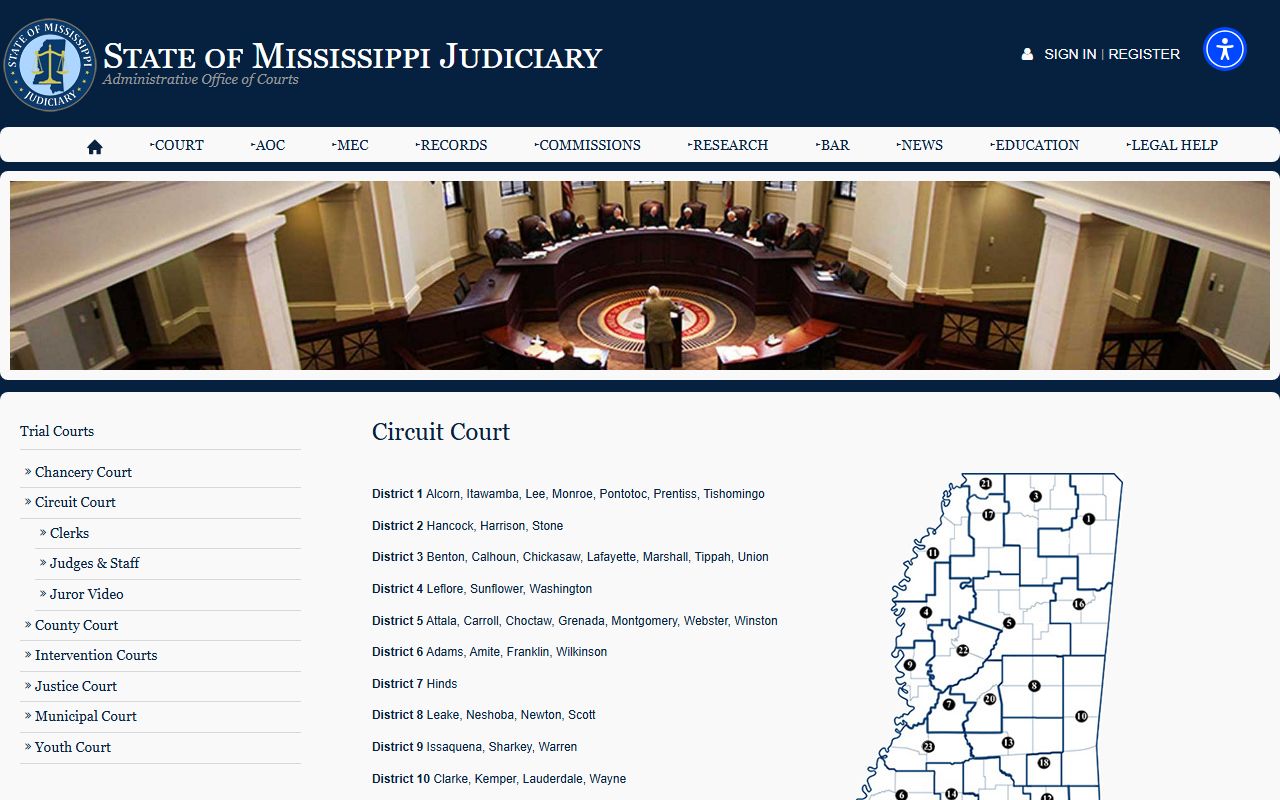
Covington County sits in the Thirteenth Circuit Court District, so its felony case files are built and stored at the circuit level. If prosecutors pursue the case, the file moves up from Justice Court. A grand jury may return an indictment, or the state may proceed by information. District Attorney Chris D. Hennis prosecutes felonies for the Thirteenth Circuit District, which covers Covington, Jasper, Simpson, and Smith counties. His office decides what to charge and how to present the case. From the indictment forward, the full felony file lives with the circuit clerk. A closer look at the charges themselves appears in the county arrest records and court charges page.
Note: A felony record in Covington County can span two courts, with the first hearing in Justice Court and the full case file in Circuit Court.
How to Search Covington County Criminal Court Records
Covington County does not run one public criminal case database. Access works through a few channels. Mississippi Electronic Courts, known as MEC, is the statewide e-filing system. Electronic filing is now complete in all circuit, chancery, and county courts. The public can view documents through Public Access Mississippi Electronic Courts, or PAMEC, after registering. Registration costs $10 per year, and document viewing runs 20 cents per page. Some sensitive categories are not open to remote viewing at all.
- Register for a public PAMEC account and sign in at the MEC public registration site.
- Search by the defendant's name or by the case number.
- Narrow the search by court, case type, and date range.
- Open the case to read the docket, the charges, and the disposition.
- Request a certified copy from the Circuit Clerk when you need one for court.
Not every file is online. Justice Court and municipal records have no public search portal. For those, call the clerk who holds the case. The Circuit Clerk takes copy requests by phone, mail, email, or at the counter. Fees for certified copies are not posted online, so call to confirm before you mail a request or arrive. For a broad look across all record types in the county, the main court records page maps each office and channel.
Stages of a Covington County Criminal Case
A criminal case moves through set stages, and each one leaves a mark in the record. The file grows as the case advances. Reading the docket in order shows where a case stands. The path below is typical for a felony tried in circuit court. Some cases end early with a plea, while others run all the way to a verdict.
Case flow: Charges Filed › Arraignment › Pretrial / Motions › Plea or Trial › Disposition › Sentencing
| Stage | What Happens |
|---|---|
| Charges Filed | The state files an affidavit, information, or grand jury indictment that names the offense and opens the case file. |
| Arraignment | The defendant is told the charges in open court and enters a plea of guilty, not guilty, or no contest where allowed. |
| Pretrial / Motions | Lawyers file motions, exchange evidence, argue bond, and set hearing dates. Orders from the judge are logged here. |
| Plea or Trial | The case ends in a plea deal, or it goes to a jury or bench trial that reaches a verdict. |
| Sentencing | After a guilty plea or verdict, the judge orders the penalty: jail or prison time, probation, fines, or restitution. |
What a Covington County Criminal Court Record Shows
The fields in a criminal court record vary by court and by access channel. A full circuit court file holds the most detail. It carries the parties, the charges, every docket entry, and the final outcome. The table below lists the core fields most files share. Financial entries such as fines, court costs, bonds, and restitution may also appear.
| Field | What It Shows |
|---|---|
| Case Number | The unique number the clerk assigns to track the file and every later filing. |
| Defendant | The person charged, listed as the party the state has brought the case against. |
| Charges | The offenses as filed, with the affidavit, information, or indictment that names them. |
| Docket Entries | The dated list of filings and events: motions, orders, hearings, continuances, and notices. |
| Plea | The defendant's formal answer, such as guilty, not guilty, or no contest where allowed. |
| Disposition | The final outcome, such as guilty, not guilty, dismissed, or a judgment entered. |
| Sentence | The penalty ordered after a conviction, including time, probation, fines, and restitution. |
Charges vs. Convictions in Criminal Records
Being charged is not the same as being convicted. A criminal court record can show charges that were later dropped, reduced, dismissed, or that ended in an acquittal. A charge is only an accusation. A conviction is a finding of guilt by plea or verdict. Reading the disposition is the only way to tell the two apart. The comparison below shows how they differ.
| Charge | Conviction | |
|---|---|---|
| Stage | Accusation at filing | Verdict or plea of guilt |
| Burden of Proof | Probable cause | Beyond a reasonable doubt |
| Can Change | Yes, may be amended, reduced, or dropped | Final unless appealed or vacated |
| Public Record | Yes | Yes |
Reading Dispositions and Sentences
The disposition is the heart of a criminal court record. It states how the case ended. Common entries include guilty, not guilty, dismissed, nolle prosequi when the state drops the charge, and no contest. Some cases show a deferred outcome, where a plea is held while the person meets court terms. A clean reading of the disposition prevents a dropped charge from being read as a conviction.
The sentence sits next to the disposition once there is a conviction. It can order prison or jail time, probation, fines, court costs, or restitution to a victim. A person sentenced to state prison passes from county custody into the state system. Those sentenced prisoners can be found through the Mississippi Department of Corrections inmate search, which is separate from any county jail file. A sentence may also be changed later by probation revocation or appeal, and those steps are added to the same case file.
Note: A deferred or withheld disposition is not the same as a conviction, so read the final order before drawing any conclusion about guilt.
Public Access to Covington County Criminal Records
Criminal court files are public records in Mississippi unless a law makes them confidential. The Mississippi Public Records Act gives any person the right to inspect or copy nonexempt records. A public body may set written request procedures, charge actual-cost fees, and ask for payment in advance. When a file holds protected data, the office redacts the exempt parts and releases the rest. Incident reports are public, while some investigative reports may be withheld.
Key Statutes:
Miss. Code Ann. § 25-61-5 - Any person may inspect or copy public records, with access generally provided within one working day and production within seven working days.
Miss. Code Ann. § 25-61-12 - Personal information of officers, judges, and prosecutors is exempt, and investigative reports may be withheld, but incident reports stay public.
Some criminal cases in this area are federal rather than county matters, and they are handled by the U.S. Attorney's Office for the Southern District of Mississippi.
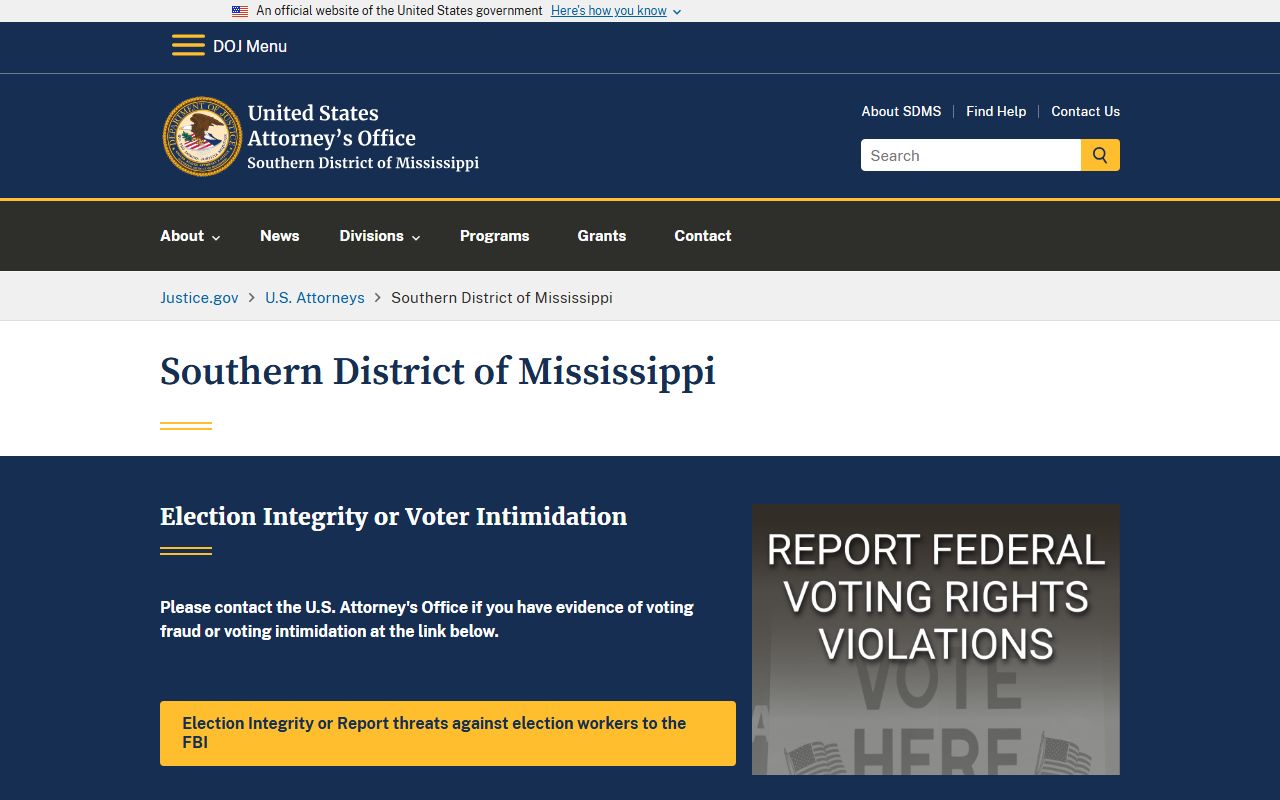
Federal charges live in the federal court system, not in the Covington County circuit clerk's files, so the two record sets stay separate. A federal case is searched through PACER, not the county courthouse.
Sealed vs. Expunged Criminal Records
Two court orders can pull a criminal record out of public view. A sealed record is blocked from ordinary public access by order or law. An expunged record is removed from public criminal-history and court channels to the extent the order requires. Even an expunged case may stay visible to agencies the law allows. Mississippi expunction is offense, disposition, and timing specific, so eligibility is never automatic.
| Sealed | Expunged | |
|---|---|---|
| Visibility | Hidden from public view | Removed from public criminal-history and court access |
| Law Enforcement | Limited access remains | Very limited; some agencies may still view it |
| How It Starts | Court order or law | Petition filed in the court over the record |
| Eligibility | Set by Mississippi law and court rule | Offense, disposition, and timing specific under Mississippi law |
The path to an expunction starts with the exact case details. The steps below outline the process for a Covington County matter.
- Gather the exact arrest, charge, court, and disposition for the record.
- For a felony or Circuit Court misdemeanor, call the Circuit Clerk; for a lower-court charge, call Justice Court first.
- If the case was bound over or indicted, also check the Circuit Court file.
- File a petition and proposed order in the court that has authority over the record.
- The judge decides whether the law allows the record to be expunged or sealed.
- If granted, the order is sent to the clerk, sheriff, prosecutor, and state criminal-history repository.
Restricted Criminal Court Records in Covington County
Not every criminal matter is open to the public. Youth Court handles delinquent children, children in need of supervision, and abused or neglected children. Those records are confidential and are not ordinary public search records. Access is limited to court staff, the parties, attorneys, and people covered by a court order. The confidentiality of these files is set by Mississippi youth-court law and the Uniform Rules of Youth Court Practice.
Sealed and expunged cases also fall outside public access. Active cases may have filings the court withholds before a hearing, and a search warrant is often sealed until it is served. Across all files, the clerk redacts protected data such as Social Security numbers, financial account numbers, victim identity details, and minor names. When a record will not appear in a public search, the next step is to ask the clerk that holds the file whether it exists and whether any part can be released.
Important: This site is not a consumer reporting agency under the FCRA, and its records may not be used for employment, tenant, credit, or other regulated screening.