
What a Court Docket Is in Covington County
A docket is the court's official log of a case. It lists each filing and each event in order, with a short date-stamped entry for every step. Think of it as the table of contents for a case. The docket shows that a complaint was filed, that a summons went out, that a motion was set for hearing, and that a judge entered an order. It does not hold the documents themselves. It points to them.
The full case file is the bigger record. It holds the actual pleadings, motions, exhibits, orders, judgments, and decrees. The docket is the index to that file. A reader uses the docket to track where a case stands and what happens next. To read the full text of a motion or an order, a person then pulls the document the docket entry refers to. In Mississippi, viewing those documents online through the state system costs twenty cents per page for public users.
The split matters for access. Many dockets can be viewed at a glance, while the full file may need a paid account, a clerk visit, or a written request. The table below sets the two side by side.
| Docket | Full Case File | |
|---|---|---|
| Content | Dated list of events and filings | The actual documents behind each entry |
| Purpose | Track case progress and next dates | Read pleadings, orders, and evidence |
| Access | Often a quick index view | May need a paid account, visit, or request |
| Cost | Listing view, with per-page charges to open documents | Twenty cents per page online; copy fees at the clerk |
How to Find Covington County Court Dockets Online
There is no one website that holds every Covington County docket. The honest starting point is the fallback chain. Statewide trial cases live in Mississippi Electronic Courts, known as MEC, with public viewing through Public Access Mississippi Electronic Courts, or PAMEC. County meeting dockets sit in a separate Board of Supervisors minutes portal. Everything else runs through the clerk who keeps the file. When a docket is not online, the path is a phone call or a visit to that clerk.
Public access to the electronic system begins with registration. The public MEC registration site is where a new user creates an account before any case can be viewed.
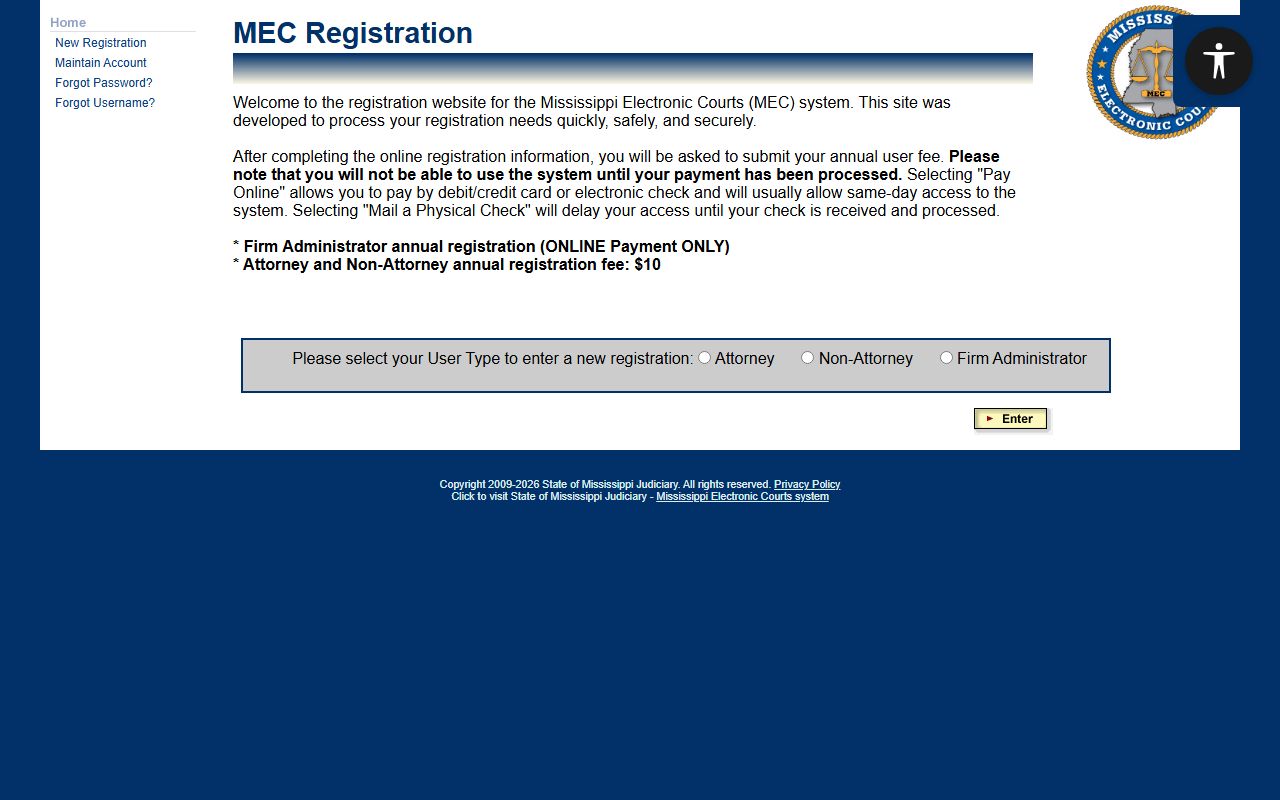
That landing page sets up the paid public account that unlocks docket and document viewing across the state's trial courts. Once an account is active, a docket search follows a clear order. Gather the party names, an approximate filing date, the case type, and a case number if one is known. Then work through these steps.
- Decide which court holds the case. Felony and major civil dockets are Circuit Court. Divorce, estate, and land dockets are Chancery Court. County tickets and small claims are Justice Court.
- Register for a public account and sign in to the MEC and PAMEC system for eligible Circuit, Chancery, and County Court dockets.
- Use the county Board of Supervisors minutes portal for meeting dockets, not for criminal or civil case dockets.
- Call or visit the Circuit Clerk, Chancery Clerk, Justice Court, or the issuing municipal court when the docket is not online.
- Turn to state agency systems for state custody, driving, and vital records that fall outside the county courts.
Searching Dockets Through MEC and PAMEC
Mississippi has finished rolling out electronic filing statewide. The Judiciary reports that MEC is live in all circuit, chancery, and county courts, which covers Covington County. The public can view case dockets and documents through PAMEC after creating an account and paying a ten-dollar annual registration fee. Document viewing then costs twenty cents per page. The Mississippi Electronic Courts page is the official entry point for system details and the helpdesk.
Registered users sign in through a short account page. The login screen asks only for the credentials tied to a paid account, not for case details. Before reaching any docket, a user must agree to the system's access rules. The PAMEC terms and conditions spell out account responsibilities and the limits on what can be viewed.
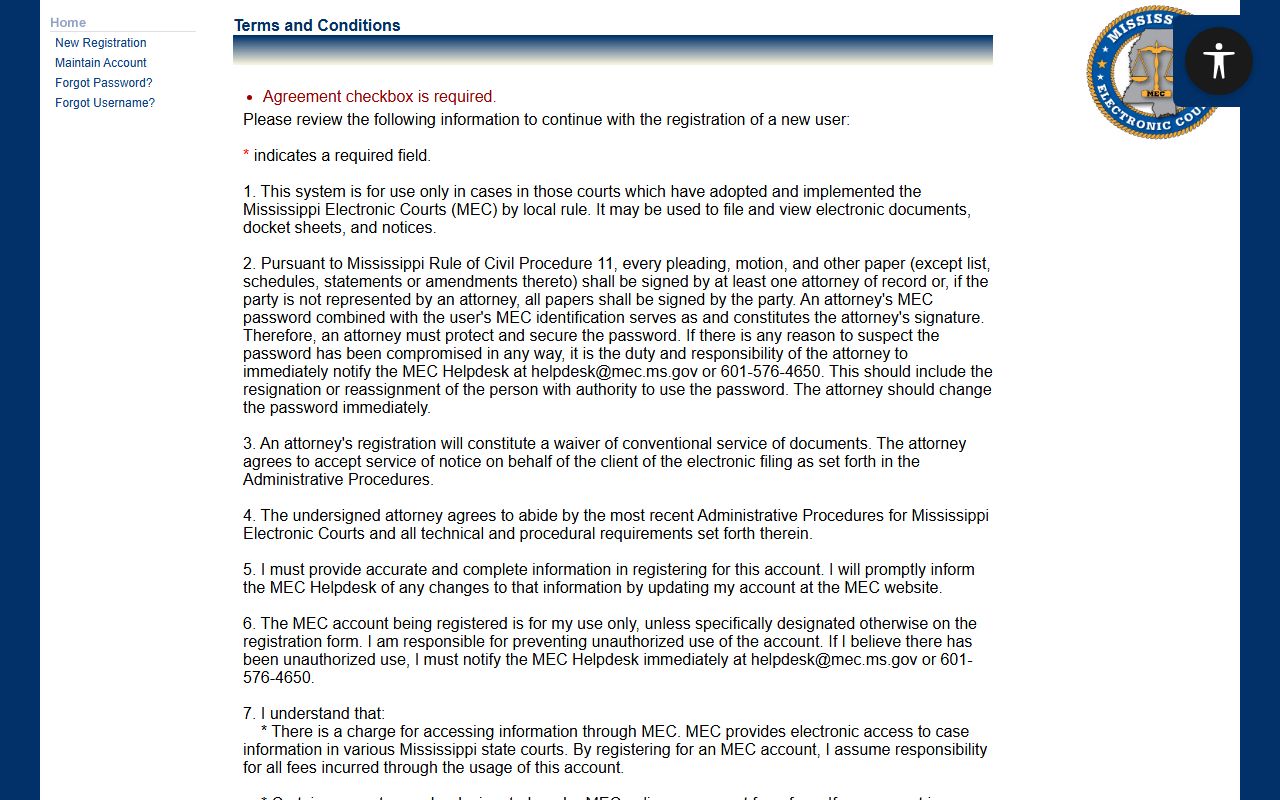
Those terms confirm that remote access is blocked for some restricted case categories, so not every docket is reachable from home. After agreeing, a returning user signs in at the account login. The MEC account-maintenance login is where credentials are entered to reach the authenticated docket interface.
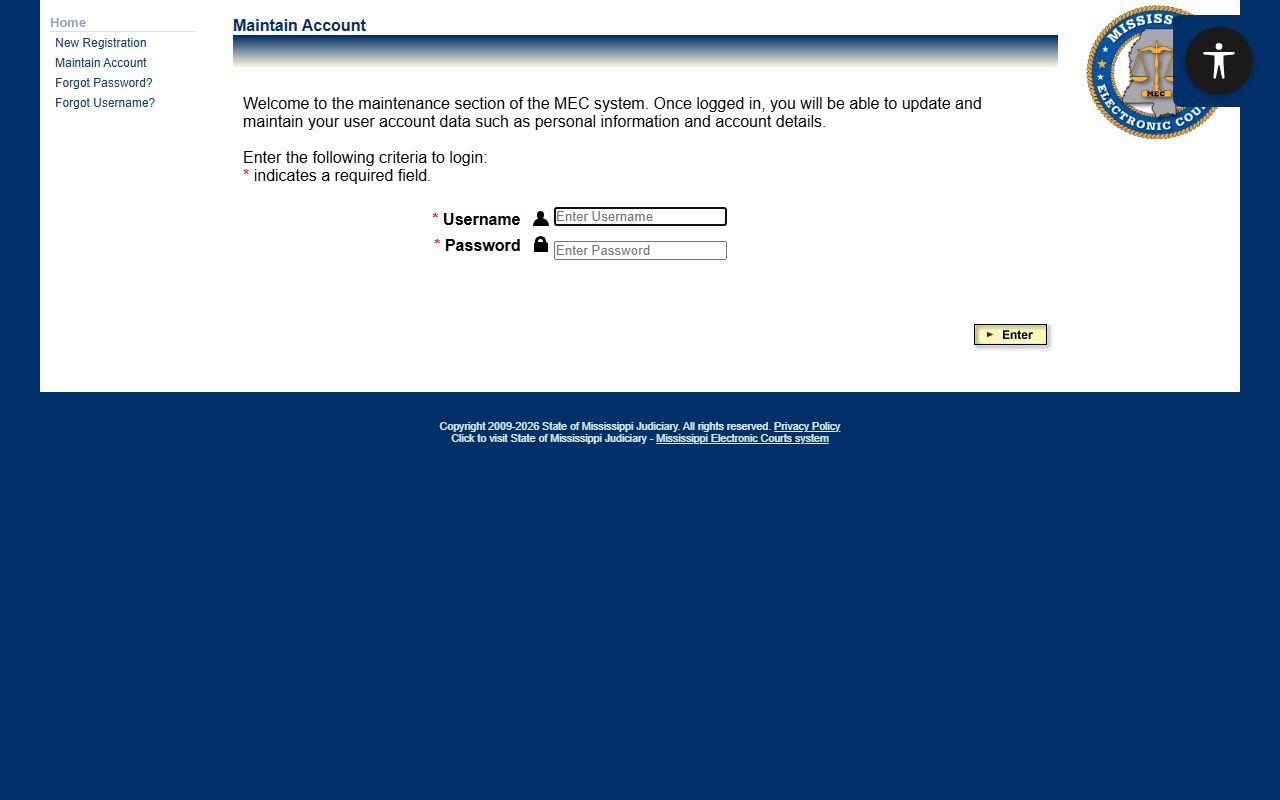
The sign-in form is brief. The fields below show exactly what the PAMEC login page requires before docket searching opens.
| Field Label | Type | Required | Notes / Format |
|---|---|---|---|
| Username | Text | Yes | Placeholder reads "Enter Username"; up to 12 characters. |
| Password | Password | Yes | Placeholder reads "Enter Password"; up to 32 characters. |
| Enter | Submit button | Yes to submit | Button labeled "Enter" runs the sign-in. |
Sidebar links on that page handle New Registration, Maintain Account, Forgot Password, and Forgot Username. The login itself is for account maintenance, so real docket searching starts only after sign-in inside the authenticated system. New users register first, pay the annual fee, and then return to view dockets.
Note: Public case searching opens only after an active paid account signs in, since the PAMEC login page handles account maintenance rather than docket lookups.
Courts That Post Dockets in Covington County
Not every court in the county puts its docket online. The split follows the court level. Circuit Court and Chancery Court dockets flow through MEC and PAMEC, since the state system is live in those courts. County Court filings, where they exist, run through the same system under the Circuit Clerk. The lower courts are different. No online docket search was located for the county Justice Court or for the Collins and Mount Olive municipal courts, so those dockets must be checked with the clerk by phone, mail, or in person.
The Chancery Clerk also runs a public meeting docket. The Board of Supervisors minutes portal lets anyone search county meeting agendas and minutes by date range, official book and page, keyword, or minute-line description. That is a public-meeting docket, not a case docket, and it does not hold criminal or civil court files. The Board Minutes search is free and needs no account. Here is how docket access breaks down by court.
- Circuit Court: felony and major civil dockets through MEC and PAMEC, with the Circuit Clerk for copies and older files.
- Chancery Court: divorce, estate, guardianship, and land-equity dockets through MEC, with restricted family categories kept off remote view.
- Justice Court: county and highway-patrol tickets, small claims, and felony first appearances, with no online docket; call the Justice Court clerk.
- Municipal Court: city ordinance and traffic dockets for Collins and Mount Olive, checked only with the city that issued the citation.
- Board of Supervisors: public meeting dockets and minutes through the free Chancery Clerk portal.
For a wider view of how these files connect, the Covington County court records overview maps each clerk to the records it keeps. Felony case dockets in particular sit with Covington County Circuit Court once a charge is bound over from Justice Court.
Inside a Covington County Docket Entry
Each line on a docket marks one event. The entries read in plain order, with the oldest at the top and the newest at the bottom. A criminal docket and a civil docket share many of the same entries, though the wording shifts with the case type. Reading them in sequence shows the whole arc of a case, from the opening filing to the closing order. The list below covers the docket entries that most often appear in Covington County case files.
| Docket Entry | What It Means |
|---|---|
| Complaint Filed | The first civil pleading that opens a case and states the claims. |
| Summons Issued | Formal notice sent to tell a party a suit has been filed. |
| Indictment Filed | A grand jury's formal felony charge, entered in Circuit Court. |
| Arraignment | Hearing where a defendant is told the charges and enters a plea. |
| Plea | The defendant's answer, such as guilty, not guilty, or no contest. |
| Motion Filed | A written request asking the judge to rule on an issue. |
| Order Entered | The judge's written directive resolving a motion or setting terms. |
| Judgment | The court's final, enforceable decision in the case. |
| Sentencing | The order setting punishment after a conviction or guilty plea. |
| Notice of Appeal | A filing that moves the case to a higher court for review. |
| Hearing Scheduled | A set date, time, and courtroom for a court appearance. |
| Continuance | A postponement that pushes a hearing or trial to a later date. |
| Final Decree | A Chancery Court order closing a divorce, custody, or equity case. |
An entry usually carries a date, a short description, and a note of who filed it. Many entries also link to the document behind them. In MEC, opening that document is the step that triggers the per-page charge. Hearing entries add a time, a courtroom, and the assigned judge, which is what makes the docket double as a case calendar.
Docket Status Terms in Covington County
A docket also carries a status flag for the case as a whole. The flag tells a reader whether the matter is still moving, has ended, or has left the court. These terms appear across Circuit, Chancery, and lower-court dockets, and they shape what a searcher should do next. The definitions below explain the status words used most often.
- Pending
- The case is filed and still active, with events yet to come.
- Open
- The file is live and accepting filings and hearings.
- Closed
- The court has finished its work and the file is no longer active.
- Disposed
- A final outcome has been reached, such as a judgment or decree.
- Dismissed
- The case was thrown out before a full ruling on the merits.
- Transferred
- The matter was moved to another court with proper authority.
- Appealed
- A party has asked a higher court to review the decision.
- Sealed
- The file is closed to ordinary public view by law or court order.
Status labels can change as a case moves. A pending case becomes disposed once a judgment lands, and a disposed case can shift to appealed if a party files a notice of appeal. A board-minutes record carries its own labels, including a draft status for minutes that are not yet final. Reading the status first saves time, since it shows whether the docket is current or historical.
Restricted and Confidential Dockets in Covington County
Some dockets never appear in a public search. Youth Court handles delinquent children, children in need of supervision, and abused or neglected children, and those records are confidential under Mississippi youth-court law. Access is limited to court staff, parties, attorneys, authorized agencies, and people named in a Youth Court order. The docket and the file alike stay closed, so a Youth Court matter should never be treated as an ordinary public-record search.
Sensitive family dockets carry similar limits. Remote access through MEC is blocked for some restricted categories, including protective-order and sensitive domestic matters. Adoption files are generally confidential, and even the fact that an adoption case exists is not an ordinary public record. Mental commitment matters in Chancery Court often hold medical and personal details and are treated as restricted. Sealed dockets are closed by court order, while expunged cases are removed from public criminal-history and court channels to the extent the order requires.
When a docket is restricted, the route is the court that holds it. A person with a legal interest can ask the clerk how to seek access and what authority is required. The Mississippi Public Records Act lets an office redact exempt material and release only the parts the law allows. For a record covered by an order, an agency allowed by law may still see the file even after it leaves public search.
Note: Youth, adoption, sealed, and protected family dockets are confidential, so confirm any access route with the clerk for the court that holds the file.